
A robot that cannot see is a robot that must be told everything. Where is the box? How far away is the wall? Is that object a cup or a shadow? Without vision, every answer must be programmed in advance, and the moment anything changes, the robot is lost. Vision is what lets a robot cope with a world that was not arranged for it — and that is why vision systems are at the heart of modern robotics.
This guide explains how robot vision systems work, from the hardware that captures light to the software that turns pixels into decisions. You will learn what cameras and depth sensors actually measure, how AI models find and track objects, how vision connects to a robot’s hands and wheels, and where vision still fails. No prior robotics knowledge is assumed; if you want the broader context first, read our explainer on what physical AI is.
Why Robots Need to See
It is tempting to think of vision as a luxury — a nice addition to a robot that already knows what to do. In practice, it is a necessity for any robot that operates outside a fully controlled cell. The reason is variation. In the real world, objects are rarely in exactly the same place twice. Boxes are stacked differently, parts arrive in different orientations, lighting changes through the day, and people move things. A robot without vision must assume the world matches its program, and that assumption breaks constantly.
Vision closes the loop between the robot’s plan and reality. Instead of moving blindly to a pre-programmed position and hoping a part is there, a vision-guided robot looks, finds the part, adjusts its approach, and verifies the result. That feedback loop is what separates a modern picking robot from a traditional machine: the robot adapts to what it sees, rather than demanding that the world adapt to it.
Vision also enables entirely new capabilities. A robot that can recognize objects can sort mixed items, inspect products for defects, read labels, follow a person, avoid obstacles it was never told about, and navigate through a building it has never visited. Each of these tasks is, at its core, a vision task first and a motion task second: the robot must understand the scene before it can act sensibly in it.
The field behind all of this is computer vision, the discipline of extracting useful information from images and video. Its methods range from classical geometry to modern deep learning, and robotics draws on all of them. A good starting point for the theory is the overview of computer vision, which covers the field’s history from early edge detection to today’s neural networks.
The Sensor Toolkit
A robot vision system begins with sensors, and the choice of sensor shapes everything downstream. The most common is the ordinary color camera, which captures the same kind of image a phone camera does. Color cameras are cheap, high-resolution, and rich in detail, which makes them ideal for recognizing objects, reading text, and understanding scenes. Their weakness is that they measure light, not distance: a photograph of a small object nearby can look identical to a photograph of a large object far away, and a robot that needs to grasp something must know which it is.
Depth sensors solve the distance problem. Stereo cameras use two lenses, like human eyes, and compute depth from the difference between the two views. Time-of-flight sensors measure how long light takes to bounce back from a surface. Structured-light sensors project a known pattern and infer depth from how it deforms. Lidar, familiar from self-driving cars, sweeps a laser beam and builds a precise three-dimensional map of the surroundings. Each method has trade-offs in range, accuracy, cost, and sensitivity to sunlight or reflective surfaces, and real robots often combine several.
Other sensors fill gaps that cameras cannot. Thermal cameras see heat, which helps in darkness or through smoke. Event cameras report only changes in brightness, which makes them extremely fast — useful for tracking fast-moving objects. Force and tactile sensors, mounted on grippers, tell the robot what cameras cannot: how hard it is squeezing, whether an object is slipping, and whether a surface is soft or rigid. A capable robot fuses these signals, because no single sensor tells the whole story.
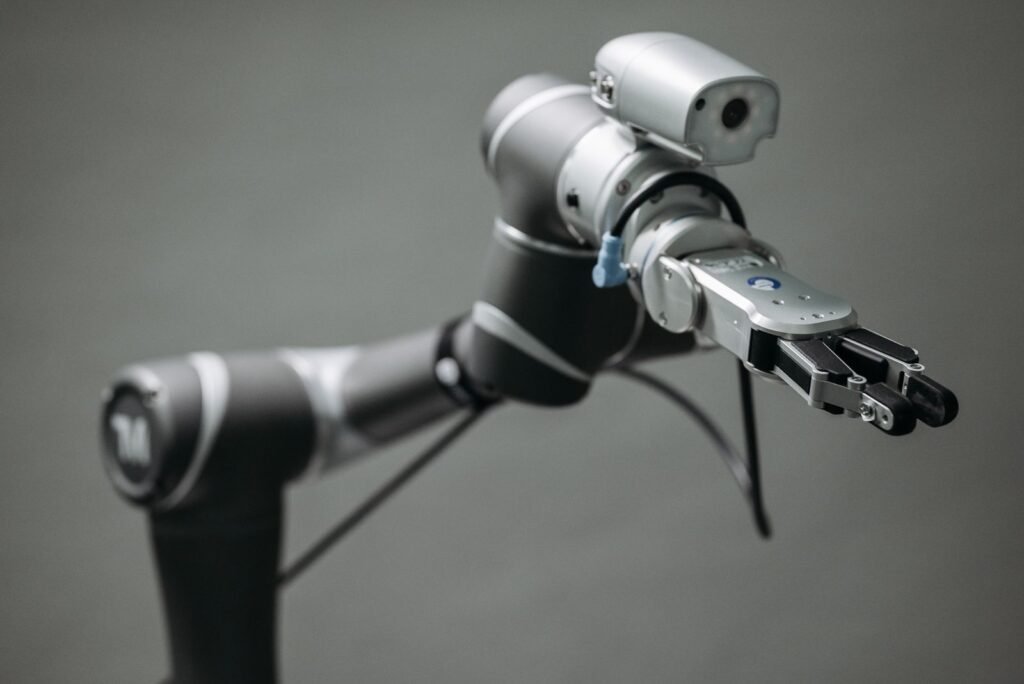
Sensor placement matters as much as sensor choice. A camera mounted on the robot’s head sees the scene roughly as a person would, which is good for navigation and interaction. A camera mounted on the wrist, looking at the gripper’s target, sees fine detail at the moment of grasping, which is good for precision. Many systems use both: a wide view for planning and a close view for execution. The trade-off is complexity, because each camera’s view must be calibrated against the robot’s body so the robot knows where what it sees actually is.
From Pixels to Understanding
Raw sensor data is not understanding. A camera delivers millions of pixel values; the robot needs answers: what objects are present, where are they, how are they oriented, and which one should I act on? Turning pixels into answers is the job of the vision pipeline, and it typically runs in stages.
The first stage is preprocessing: correcting lens distortion, adjusting for lighting, and cleaning up noise so later stages work with the best possible input. This sounds mundane, but it matters enormously. A model trained on clean images will fail on images with glare, motion blur, or color shifts unless preprocessing reduces those effects.
The second stage is detection and segmentation: finding objects and marking which pixels belong to each one. Modern systems use deep neural networks trained on large datasets of labeled images. A detector might output bounding boxes around every box, bottle, and tool in view; a segmentation model goes further, marking the exact outline of each object. For a picking robot, segmentation is often essential, because the robot needs to know not just that a box exists but exactly where its edges are and which face is graspable.
The third stage is pose estimation: determining each object’s position and orientation in three dimensions. A robot cannot grasp an object it has located only in a flat image; it needs to know where the object is relative to its own hand, and how it is rotated. Pose estimation combines the camera image with depth data and, often, a known model of the object’s shape. For familiar objects, this works well. For unfamiliar or deformable objects — a bag of clothes, a coiled cable, a bunch of grapes — it remains genuinely hard.
The fourth stage is tracking and prediction: following objects over time and anticipating where they will be. A robot handing an item to a person must track the person’s hand as it moves. A mobile robot avoiding pedestrians must predict where each person will walk next. Tracking turns a series of still pictures into a living understanding of a dynamic scene, and it is where many systems show their limits: occlusions, where one object hides another, can break tracking in ways that are obvious to a human but confusing to a machine.
Classical computer vision libraries remain the workhorses for much of this pipeline. OpenCV, the open-source computer vision library, provides the building blocks — image processing, camera calibration, feature detection, and more — that countless robot vision systems are built on, and it is a good place to explore the practical side of the field.
How Vision Connects to Action
Understanding a scene is only half the job. The vision system must hand its conclusions to the robot’s planning and control systems in a form they can use, and it must do so fast enough to matter. A robot that takes two seconds to recognize an object it must catch has already failed; a picking robot that pauses for a second on every item loses the throughput that justifies its existence.
This connection is usually made through a shared world model: a constantly updated representation of the robot’s surroundings, including object positions, the robot’s own pose, and obstacles. The vision pipeline writes into this model, and the planner reads from it. When vision updates the model — an object moved, a person stepped into the path — the planner adjusts. When the planner needs information — is there space to place this item here? — it queries the model. Keeping this model accurate and current is a systems engineering challenge as much as a vision challenge, because stale or inconsistent data produces confident, wrong actions.
Two patterns of vision-guided action are worth knowing. In visual servoing, the robot continuously adjusts its motion based on what the camera sees, steering its gripper toward a target the way you steer your hand toward a cup while watching it. This is robust to small errors, because the loop corrects itself. In look-then-move systems, the robot takes a picture, computes a plan, and executes it without further visual feedback — faster, but vulnerable if anything shifts during execution. Most real systems combine both: a planned approach guided by vision, with visual servoing for the final, precise approach.
Latency and calibration deserve emphasis here. Every millisecond of delay between seeing and acting is a millisecond in which the world may have changed. And if the camera is miscalibrated by even a small amount — if the robot thinks the camera points slightly differently than it does — every grasp will miss by a consistent, maddening offset. Calibration is tedious, unglamorous work, and it is one of the most common sources of real-world robot failures.
What Still Goes Wrong
Robot vision has improved enormously, but it still fails in ways that are instructive, because the failures reveal what vision really requires.
Lighting is the classic enemy. A system trained in bright, even light may fail in dim corners, under harsh spotlights, or when sunlight streams through a window and creates glare. Humans adapt to lighting changes effortlessly; cameras and models do not, unless they were specifically trained or designed to. Warehouses and factories often control lighting precisely for this reason, and the step from a lit facility to an uncontrolled environment is one of the hardest in robotics.
Transparency and reflectivity are another persistent problem. Glass, clear plastic, shiny metal, and liquids confuse depth sensors and cameras alike, because they do not reflect light the way ordinary surfaces do. A robot that must handle glass bottles or polished parts needs special techniques, and even then it may struggle. This is a good example of a problem that looks trivial to a person — you can see the bottle perfectly well — but is genuinely hard for a machine.
Occlusion and clutter are a third problem. In a bin full of mixed items, most objects are partly hidden, and the robot must decide which item to grasp and how, without disturbing the rest. Humans do this intuitively; robots must reason about hidden geometry and the physics of the pile. Bin picking remains a benchmark problem in robotics precisely because it combines perception, planning, and manipulation in a genuinely hard setting.
Finally, there is the long tail of unusual cases. A model trained on thousands of examples of boxes will still meet a box it has never seen: crushed, taped oddly, printed with a confusing pattern. Robustness to the unexpected is the difference between a lab system and a production system, and it is earned through diverse training data, careful testing, and fallback behaviors — what should the robot do when it is unsure? The best answer is usually to stop and ask, or to choose a safe, conservative action, rather than to guess confidently.
Vision in Simulation vs Vision in Reality
An important nuance is that much robot vision development happens in simulation, where images are clean, lighting is controllable, and ground truth is free. A vision model trained entirely on simulated images often performs worse on real camera footage, because real images contain sensor noise, lens artifacts, motion blur, and lighting quirks that the simulator never produced. This gap between simulated and real vision is a well-known problem, and teams address it in several ways: making simulations more photorealistic, randomizing simulated conditions so the model learns robustness rather than memorizing one setup, and fine-tuning simulated models on a smaller set of real images. The practical lesson is to treat simulation as a starting point for vision, not a substitute for real-world testing. Collect images from your actual deployment environment early, test against them regularly, and expect the first real-world trial to reveal problems no simulation showed. That cycle — simulate, test in reality, fix, repeat — is how production vision systems are actually built.
Choosing and Building a Vision System
For readers considering robot vision — whether as hobbyists, students, or engineers — a few practical guidelines help.
Start with the task, not the sensor. A system for reading barcodes needs a different setup from a system for picking mixed objects, and both differ from a navigation system. Define what the robot must perceive, at what distance, in what lighting, and how fast, and let those requirements choose the sensors. Buying the most expensive camera first and figuring out the task later is a reliable way to waste money.
Prefer proven components. Cameras, depth sensors, and libraries like OpenCV are mature and well documented; building a vision system from them is far easier than inventing new methods. Modern AI models for detection and segmentation are available as pre-trained starting points, and fine-tuning them on your specific objects usually beats training from scratch.
Test in the real environment early. Vision systems that work beautifully on a desk often fail in the actual warehouse, workshop, or field, because real lighting, dust, vibration, and clutter differ from lab conditions. Collect images from the real deployment site, label them, and test against them before committing to a design.
And build in fallbacks. No vision system is perfect, so decide in advance what the robot does when confidence is low: retry from a different angle, ask a human, skip the item, or stop safely. A system with a graceful failure mode is worth more than a slightly more accurate system that fails catastrophically.
Robot vision is the sense that makes modern robotics possible, and it is improving fast — but it improves fastest for people who understand its limits as well as its strengths. For more on the machines that use these systems, see our comparison of humanoid robots vs traditional industrial robots, and browse the Robotics & Physical AI category and the TechBist blog for related guides. You can also start from the TechBist homepage whenever you need a plain-language explanation of a new technology.
Frequently Asked Questions
Do robots see the way humans do?
No, not really. Humans see a rich, meaningful world effortlessly, filling in gaps and understanding context. Robots see arrays of numbers from sensors and must compute meaning from them step by step. A robot can outperform a human at measuring distances or spotting tiny defects, but it still struggles with tasks humans find trivial, like recognizing an object in unusual lighting or understanding a cluttered scene at a glance.
Why do robots need depth sensors if they have cameras?
Because a flat image does not tell you how far away something is, and grasping requires distance. A small object nearby and a large object far away can produce identical images. Depth sensors measure distance directly, which lets the robot locate objects in three-dimensional space and plan a gripper approach that actually reaches the target.
Can a robot vision system work in the dark?
Partly. Ordinary cameras need light, but thermal cameras, infrared sensors, and lidar work without visible light, and some robots carry their own illumination. A system designed for darkness uses different sensors and different training data from one designed for daylight. Vision in complete darkness with no active sensing is not possible, which is why many robots combine several sensor types.
What is the hardest problem in robot vision?
Arguably, robustness: performing reliably across the endless variation of the real world. Individual tasks — detecting a known object in good light, for example — are largely solved. Doing so for unfamiliar objects, in bad light, partly hidden, while moving, and with the reliability a production system needs, remains the central challenge.
Do I need expensive hardware to learn robot vision?
No. A standard webcam, a modest computer, and open-source tools like OpenCV are enough to learn the fundamentals: image processing, detection, tracking, and camera calibration. Depth cameras and small robot arms add realism later, but the core concepts can be learned with equipment most people already own.
1 thought on “How Robot Vision Systems Work”