
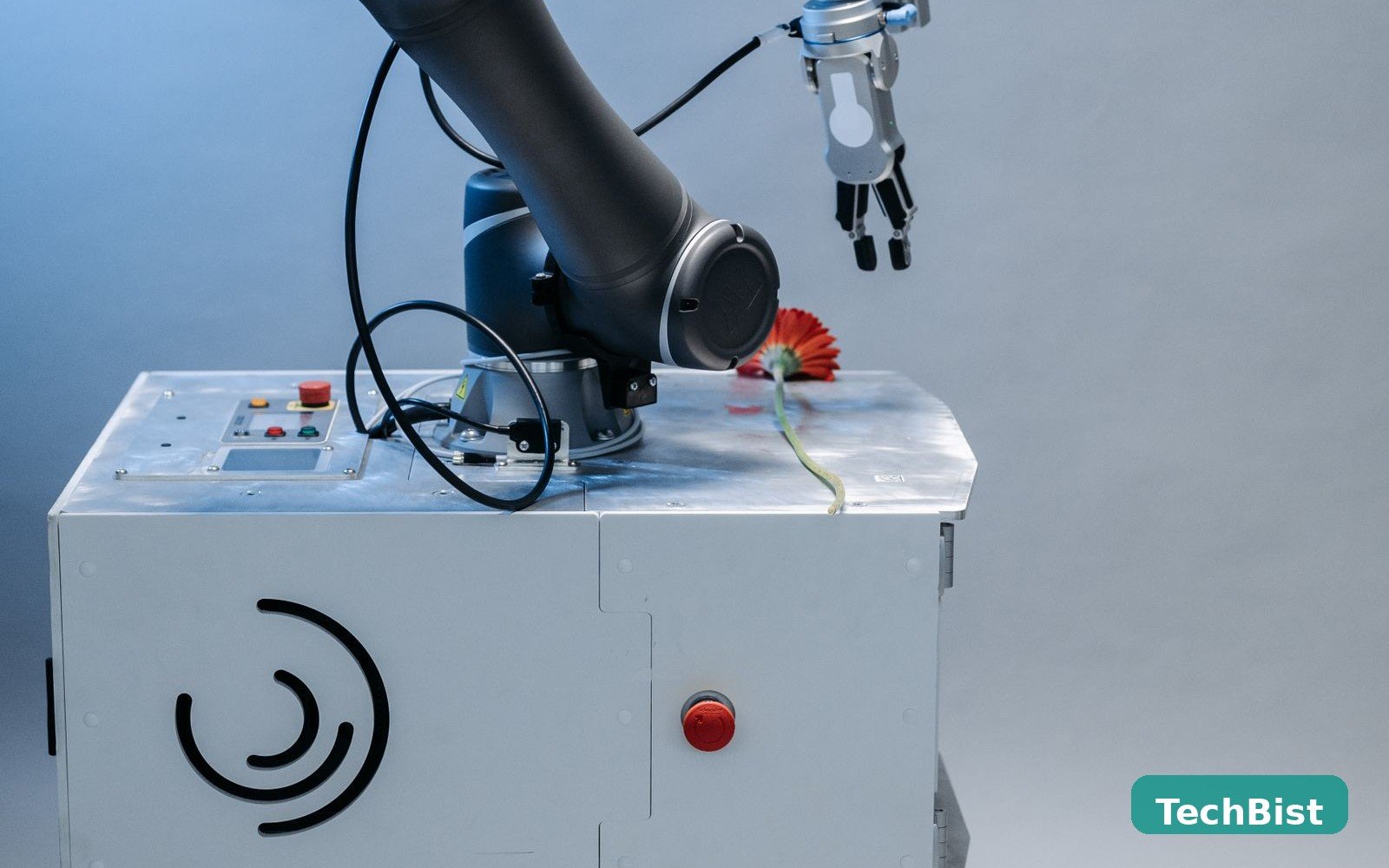
Training a robot in the real world is slow, expensive, and sometimes dangerous. A robot learning to walk by trial and error will fall thousands of times; a robot learning to grasp will drop countless objects; a robot learning to drive will crash. Simulation offers an obvious escape: train the robot in a virtual world where falls are free, time can be sped up, and thousands of robots can learn in parallel. There is just one problem — what a robot learns in simulation does not always work in reality.
This gap between the virtual and the real is one of the central challenges in modern robotics, and closing it is called sim-to-real transfer. This guide explains what the reality gap is, why it exists, the main techniques researchers and engineers use to close it, and what it means in practice for anyone building robots. If you are new to the robots themselves, our guide to AI-powered autonomous mobile robots is a good place to start.
Why Simulation Is So Attractive
Simulation is attractive for reasons that go beyond avoiding broken hardware. The first is scale. A reinforcement learning algorithm might need millions of trial-and-error episodes to learn a skill. In the real world, that could take months of continuous operation. In simulation, the same episodes can run in parallel across many virtual robots and finish in hours or days. Time itself can be accelerated: a simulator running faster than real time compresses weeks of experience into an afternoon.
The second reason is safety and control. In simulation, you can test dangerous scenarios — a robot near a cliff edge, a manipulator near a person, a drone in high wind — without any risk. You can also create situations that are rare in reality but critical to handle: sensor failures, unusual lighting, objects in unexpected places. A robot that has only ever seen clean, well-lit rooms will fail the first time it meets reality’s messiness, and simulation lets you prepare for that messiness deliberately.
The third reason is cost. Physical robots are expensive to buy, maintain, and repair, and real-world testing needs space, supervision, and safety procedures. Simulation lets small teams and students experiment with robots they could never afford, and lets large teams test ideas before committing to hardware. It is no surprise that simulation has become a standard first step in robotics development, supported by mature tools and platforms such as NVIDIA’s Isaac Sim, which is built specifically for robotics simulation and synthetic data generation.
The Reality Gap: Why Transfer Fails
The reality gap is the difference between the simulated world and the real one, and it appears in several forms. Physics is the first. Simulators approximate physics: friction, contact forces, joint flexibility, and material deformation are all modeled with simplifications, and those simplifications are wrong in detail. A grasp that works in simulation may slip in reality because the friction coefficient was slightly different; a walking gait that is stable in simulation may wobble on a real floor because the robot’s mass distribution differs from the model.
Sensors are the second source of gap. A simulated camera produces clean, perfectly rendered images; a real camera produces noise, lens distortion, motion blur, and glare. A simulated lidar returns exact distances; a real lidar has noise, dropouts, and reflections from glass and shiny surfaces. A policy trained on clean simulated sensor data can be badly confused by the messy data of the real world, even when the underlying task is the same.
The third source is everything the simulator leaves out. Real environments contain clutter, wear and tear, loose cables, changing light, and people doing unpredictable things. No simulator models all of this, and the unmodeled details are often exactly what breaks a transferred policy. The reality gap is therefore not a single bug to fix, but a family of mismatches between a model of the world and the world itself, and closing it requires attacking several mismatches at once.
Domain Randomization
The most influential idea for closing the gap is domain randomization: instead of trying to make the simulator exactly match reality, you randomize the simulator so widely that reality looks like just another variation the robot has already seen. Randomize colors, textures, lighting, camera angles, friction, masses, sensor noise, and object positions. Train the robot across all of it. Then, when the robot meets the real world, the real world’s particular combination of properties is within the range it has already learned to handle.
The idea is powerful because it changes the goal. You no longer need a perfect simulator; you need a simulator whose range of variation covers reality. The technique of domain randomization has been used to train robotic hands to manipulate objects, drones to fly, and arms to grasp, with policies transferring to real hardware without any real-world training at all in some celebrated cases.
Domain randomization has limits, though. Randomize too little, and reality still falls outside the range. Randomize too much, and the robot learns a conservative policy that works everywhere but excels nowhere — it may grasp slowly and cautiously because it has learned that objects could be slippery, heavy, or oddly shaped. Finding the right range of randomization is an engineering skill, and it depends on knowing roughly how the real world varies, which itself requires real-world measurements. Randomization is a bridge, not a magic wand.
Better Simulation: Physics, Rendering, and Digital Twins
A complementary approach is to make the simulator better. Physics engines have improved dramatically, with more accurate contact models, deformable materials, and realistic joint dynamics. Rendering has improved too: modern simulators use physically based rendering and ray tracing, producing images that are much closer to what a real camera sees, including reflections, shadows, and realistic lighting. Better simulation shrinks the gap directly, so less randomization is needed.
System identification is another tool: measuring the real robot carefully — its masses, friction, motor delays, sensor noise — and tuning the simulator to match. This is painstaking work, but it pays off when a policy must transfer precisely, such as for a manipulator doing delicate assembly. The extreme version of this is the digital twin: a simulated replica of a specific facility or robot, kept in sync with its real counterpart through sensor data, so that policies can be tested against an up-to-date model of the actual deployment environment.
A related technique is to mix simulated and real data. A policy can be pre-trained in simulation and then fine-tuned with a small amount of real-world data — far less than training from scratch. Or the simulator can be improved using real data: a learned model of the differences between simulated and real outcomes can correct the simulator, a technique sometimes called residual learning. In practice, most successful deployments combine several of these approaches rather than relying on any one of them.
Closing the Gap in Practice
For practitioners, sim-to-real transfer is a workflow, not a single trick. Start by defining what success looks like on the real robot, and build a test procedure that measures it honestly. Then train in simulation with randomization over the properties you know vary in reality, informed by measurements where possible. Transfer to the real robot in stages: first in a controlled setting, then in the full environment, watching for the specific failure modes — slips, misperceptions, hesitations — that reveal which part of the gap is biting.
Keep a tight loop between simulation and reality. When the real robot fails, reproduce the failure in simulation if you can, fix it there, and re-test. When a failure cannot be reproduced, that itself is information: it tells you what your simulator is missing, and you can extend the simulator or the randomization to cover it. Over time, this loop produces both a better policy and a better simulator, and the organization builds a library of knowledge about its particular robots and environments.
It is also worth being honest about when sim-to-real is not the right approach. For some tasks, especially those involving complex contact with deformable materials — folding cloth, handling food, working with cables — simulation is still too inaccurate, and direct real-world learning or classical control may be more practical. The field is advancing fast, but the reality gap is a research frontier, not a solved problem, and choosing the right approach for the task is part of the engineering judgment.
Another practical habit that pays off is versioning everything together: the simulator version, the randomization settings, the training code, and the policy itself. When a transferred policy behaves differently after an update, the cause is often a silent change in one of these components — a physics engine update, a tweaked friction default, a regenerated dataset. Teams that version and log their simulation setup can reproduce results and diagnose regressions quickly; teams that do not spend days chasing ghosts. Sim-to-real transfer rewards the same discipline as any engineering effort: careful records, controlled changes, and honest measurement of what actually happened on the real robot.
To keep learning, explore the Robotics & Physical AI category and the TechBist blog for related guides, and start from the TechBist homepage whenever you need a plain-language explanation of a new technology.
Sim-to-Real for Manipulation vs Locomotion
The reality gap does not bite equally everywhere, and the differences between manipulation and locomotion illustrate why. Locomotion — walking, running, balancing — is dominated by contact physics: feet striking the ground, friction, joint torques, and balance. Simulators model rigid-body dynamics reasonably well, so locomotion policies often transfer with moderate randomization and fine-tuning. The failures that do occur tend to be physical: a gait that works on a simulated flat floor stumbles on a real floor with slight unevenness, or a legged robot’s actuators respond a fraction slower than the model assumed.
Manipulation is harder. Grasping involves contact between complex shapes, friction that varies with material and wear, and objects that deform, slip, or roll. A simulator’s contact model is an approximation, and small errors in friction or geometry change whether a grasp holds. Vision adds another layer: a manipulation policy must recognize objects, estimate their pose, and choose grasp points, all from camera images that differ between simulation and reality. This is why manipulation benchmarks often show larger sim-to-real drops than locomotion benchmarks, and why manipulation research invests so heavily in domain randomization and real-world fine-tuning.
The practical lesson is to match the technique to the task. For locomotion, invest in accurate system identification and moderate randomization. For manipulation, invest in visual randomization, diverse object sets, and real-world data collection, because the gap is wider and the failure modes are more varied. Treating all robot skills as if they had the same gap leads to wasted effort in one area and underinvestment in the other.
Measuring Transfer Success
How do you know whether sim-to-real transfer worked? The honest answer requires measurement on the real robot, not just in simulation. A policy that scores perfectly in simulation but succeeds only half the time on hardware has not transferred, whatever the simulation metrics say. Good practice defines real-world success criteria before training begins: grasp success rate on a defined object set, navigation success over a defined route set, or task completion time under defined conditions.
It also helps to measure the gap itself: run the same policy in simulation and reality on matched tasks, and record where they diverge. If failures cluster around particular objects, lighting conditions, or surfaces, that tells you what to randomize or model better. Some teams maintain a “gap log” — a running record of sim-to-real discrepancies and their fixes — which becomes an institutional asset, saving future projects from rediscovering the same pitfalls.
Finally, report transfer honestly. A result that says “trained in simulation, 90 percent success on the real robot after 100 real-world fine-tuning episodes” is more useful than a claim of pure zero-shot transfer that hides extensive real-world tuning. The field progresses faster when researchers and engineers describe exactly what it took to cross the gap, because the next team can then build on a realistic picture rather than a heroic one.
The Role of Real-World Data Collection
Simulation can only take you so far, and every serious sim-to-real effort eventually invests in real-world data collection. This does not mean abandoning simulation; it means using real data strategically. Teleoperation is one common method: a human drives the robot through tasks while sensors record everything, producing demonstration data that captures real physics, real sensor noise, and real environmental messiness. Even a modest amount of teleoperated data can dramatically improve a simulation-trained policy, because it grounds the policy in the actual distribution it will face.
Another method is autonomous data collection: robots running in controlled real environments, attempting tasks, succeeding or failing, and logging the outcomes. This is slower than simulation and needs supervision, but it produces data that simulation cannot — including the edge cases and failure modes that only reality provides. Some teams run “data collection fleets”: robots whose primary job for a period is not production work but gathering diverse, labeled experience across many situations.
The key principle is to treat real-world data as a complement to simulation, not a replacement. Simulation provides scale and coverage; real data provides grounding and correction. A good rule of thumb is to start with simulation, measure the gap on the real robot, and then collect real data specifically targeted at the observed failures — new objects, new lighting, new surfaces — rather than collecting randomly. Targeted data collection closes the gap far faster than either approach alone, and it builds an asset that improves every future project on the same hardware.
Simulation for Safety-Critical Testing
One of simulation’s most valuable roles has nothing to do with training: it is a testing ground for safety. Before a robot is allowed near people, it should face thousands of simulated edge cases — sensor failures, sudden obstacles, slippery floors, unexpected human movements — and demonstrate safe behavior in each. This kind of systematic safety testing is impractical in the real world, where each scenario must be staged, supervised, and repeated, but it is routine in simulation, where scenarios can be generated, randomized, and run overnight.
Safety testing in simulation also supports certification. Regulators and safety engineers increasingly accept simulation evidence as part of a safety case, provided the simulator is validated against real-world data and the test coverage is documented. The argument is not that simulation replaces real testing, but that it extends it: real testing validates the simulator and the final system, while simulation provides the breadth of coverage that real testing cannot. Teams that build this testing discipline early find certification smoother, because they can show not just that the robot works, but that it has been tested against the situations where it might fail.
Frequently Asked Questions
What exactly is the reality gap?
The reality gap is the difference between a simulator’s model of the world and the real world itself: physics approximations, sensor noise, and unmodeled details like clutter and wear. A policy trained in simulation can fail in reality because it learned to rely on simulated details that do not hold in the real world, or because it never encountered real-world variations.
Does domain randomization always work?
No. It works best when the range of randomization covers the real world’s variation. Randomize too narrowly and reality still surprises the robot; randomize too broadly and the robot learns an overcautious policy. It is most effective when combined with good simulation, real-world measurements, and a small amount of real-world fine-tuning.
Can a robot be trained entirely in simulation and deployed without real-world training?
Sometimes, yes — this is called zero-shot transfer, and it has been demonstrated for grasping, locomotion, and navigation in research settings. In production, most teams still do at least a small amount of real-world testing and fine-tuning, both to catch remaining gaps and to satisfy safety requirements.
Is simulation replacing real-world testing?
No. Simulation reduces the amount of real-world testing needed and makes it safer and more targeted, but it does not replace it. Real-world testing remains essential for validation, safety certification, and discovering the failures that simulation cannot predict.
What tools do I need to start with sim-to-real?
Start with a robotics simulator such as Gazebo or Isaac Sim, a robotics framework such as ROS 2, and a learning framework such as PyTorch. Our guides to robotics simulation software and to ROS 2 for beginners cover the first steps, and the best way to learn is to train a simple simulated robot skill and attempt the transfer to a real or more realistic setup.
1 thought on “Sim-to-Real Transfer in Robotics Explained”