
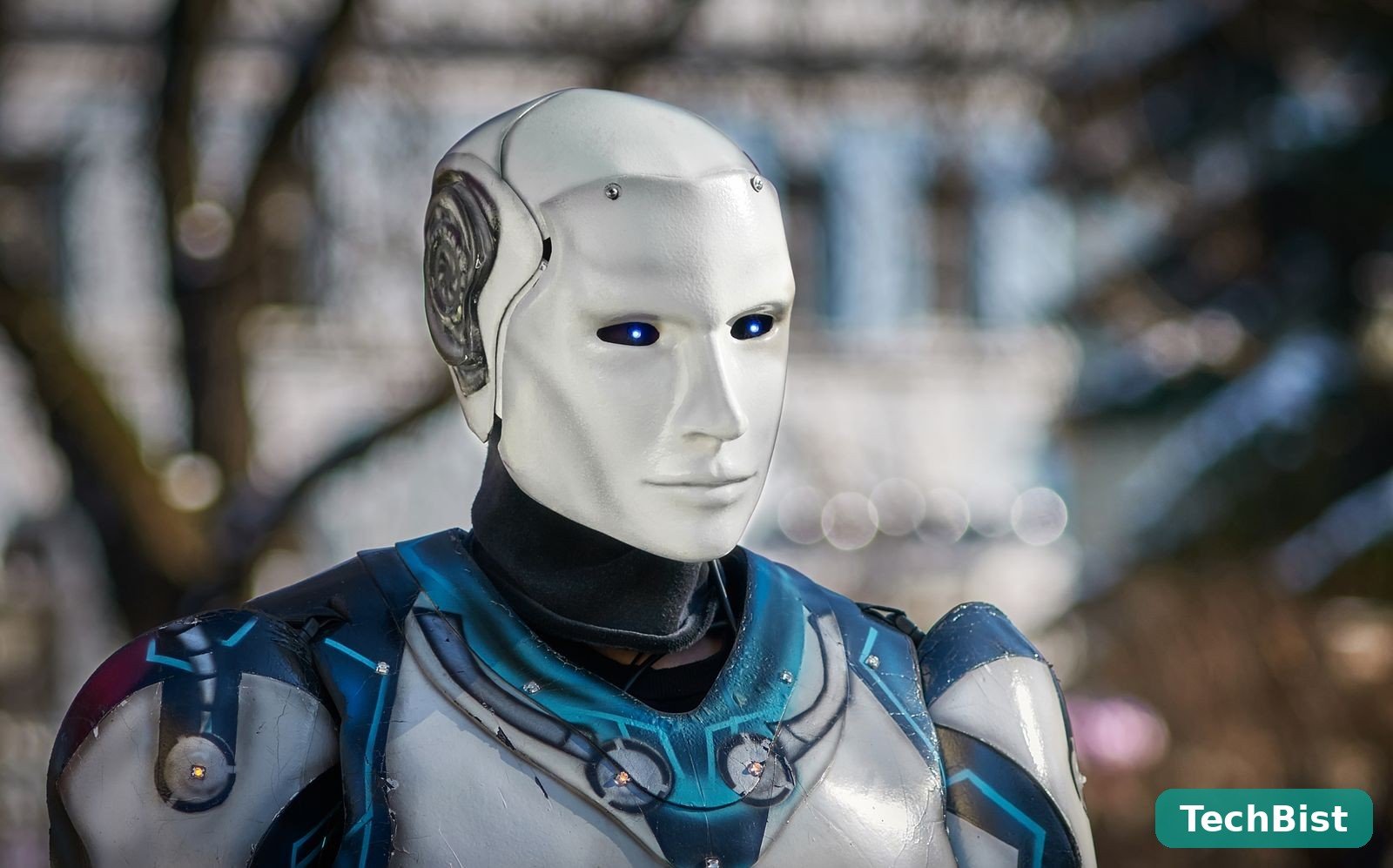
Humanoid robots dominate the headlines. Videos of two-legged machines walking, carrying boxes, and waving at cameras rack up millions of views, and it is easy to come away thinking the factory of the future will be staffed by metal people. Meanwhile, the robots that actually do most of the world’s robotic work look nothing like people at all: they are arms bolted to the floor, machines on rails, and wheeled platforms that glide between shelves. They are less photogenic and far more productive.
This guide compares the two honestly. What is a humanoid robot, really? What is a traditional industrial robot, really? What is each one good at, what does each one cost, and where does each one make sense? The answer is less dramatic than the headlines, and more useful: these are tools for different jobs, and the right choice depends on the task, the environment, and the economics — not on which machine looks more impressive in a video.
If you are new to the field, start with our explainer on what physical AI is for the foundations of robots that perceive, decide, and act in the real world.
What Counts as a Humanoid Robot?
A humanoid robot is a robot with a broadly human-like body plan: a torso, a head, two arms, and two legs, designed to operate in environments built for humans. The key idea is compatibility. Human environments — stairs, doorways, shelves at human height, tools with handles shaped for hands — were designed around the human body. A robot shaped like a human can, in principle, use that infrastructure without it being redesigned: it can climb stairs, open doors, and pick up tools made for human hands.
In practice, building a humanoid is one of the hardest problems in robotics. Walking on two legs requires continuous balance control: every step is a controlled fall, recovered by shifting weight and placing the next foot precisely. The robot must coordinate dozens of joints while carrying its own weight, managing its center of mass, and reacting to uneven ground or an unexpected push. Arms add further complexity, because manipulating objects while balancing is a whole-body problem, not two separate ones.
Humanoids also carry a heavy sensor and computing load. They need vision to navigate and manipulate, force sensing to grip without crushing, and enough onboard processing to make decisions in real time. All of that consumes power, and power is scarce: a humanoid must carry its own batteries, and every kilogram of battery is a kilogram the legs must move. This is why many impressive humanoid demonstrations are short. Running for minutes in a controlled space is a very different achievement from working an eight-hour shift.
The category is worth defining carefully, because the word “humanoid” covers a wide range. Some humanoids are research platforms built to study walking and manipulation. Some are teleoperated, meaning a human operator drives them remotely, and the “autonomy” on display is really human skill. Some are genuine attempts at general-purpose workers. When you watch a video, it is worth asking which kind you are seeing, because the distinction changes what the demonstration proves.
For the technical background on how humanoid bodies are designed and classified, the overview of humanoid robots is a solid starting point.
What Traditional Industrial Robots Do Best
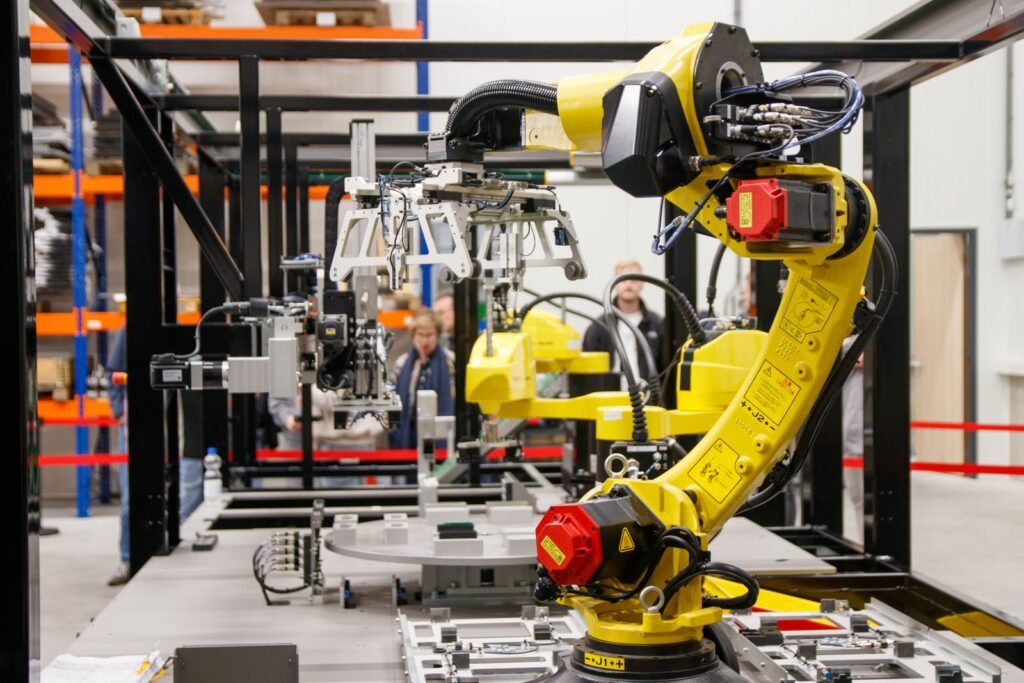
Traditional industrial robots are the work horses of modern manufacturing, and they have earned that position over decades. The most common form is the articulated arm: a chain of joints mounted on a fixed base, typically with six axes of movement, capable of reaching into a defined workspace with extraordinary precision. Other common forms include SCARA arms for fast, flat assembly work, delta robots for high-speed picking, and Cartesian gantries that move along rails.
Their defining strength is repeatability. A well-tuned industrial arm can repeat the same motion with sub-millimeter accuracy, hour after hour, for years. That precision is what makes modern car manufacturing, electronics assembly, and packaging possible at their current scale and quality. A welding robot does not get tired, bored, or distracted, and it does not need a break. For tasks that are identical every time, nothing beats it.
Their defining weakness is inflexibility. Traditional industrial robots are programmed, not trained. Engineers define exact positions, speeds, and sequences, and the robot executes them. Move a part by a few centimeters, change the lighting, or introduce a new product variant, and the program must be adjusted — often by a specialist, often with downtime. They also need a controlled environment: safety cages or fenced cells keep people out of the robot’s workspace, because a fast-moving arm cannot reliably avoid a person who steps into its path.
This is not a flaw in the design; it is a trade-off that was deliberately chosen. By removing uncertainty from the environment, engineers could achieve speed and precision that would be impossible otherwise. The result is a machine optimized for one thing: doing the same task, perfectly, forever. That optimization is exactly why industrial robots are so successful — and exactly why they struggle with tasks that change.
The history and technical foundations of these machines are well documented in the overview of industrial robots, which covers their types, programming, and the safety standards that govern their use.
Head-to-Head: The Differences That Matter
Comparing the two types side by side makes the trade-offs concrete.
Mobility is the first difference. A traditional arm is fixed; its workspace is the volume its joints can reach, and anything outside that volume is someone else’s problem. A humanoid can move through a facility, climb stairs, and reach different workstations, which makes it far more flexible in principle. But that mobility comes at a price: a walking robot is slower, less stable, and less precise than a fixed arm doing the same manipulation task. If the job is at one workstation, mobility adds cost without adding value.
Manipulation is the second difference. Industrial arms are designed for specific grippers and specific parts, and they excel within that narrow range. Humanoid hands aim for generality — the ability to grasp many different objects the way a person does — but general-purpose hands are still far clumsier than human hands and often less reliable than a specialized industrial gripper. A humanoid that can pick up a mug, a box, and a tool is impressive; a specialized gripper that picks up ten thousand identical parts without a single failure is profitable.
Speed and payload are the third difference. Industrial robots move fast and lift heavy loads relative to their size, because their structure is optimized for the task and anchored to the ground. Humanoids must support their own weight and maintain balance, which limits both speed and payload. A humanoid carrying a heavy box up stairs is an engineering feat; an industrial arm moving the same box across a workstation is routine.
Cost is the fourth difference, and it is stark. A standard industrial arm is a mature, mass-produced product with known pricing, maintenance, and support. Humanoids are still largely low-volume, custom or semi-custom machines with high unit costs, specialized maintenance, and uncertain lifespans. Even if a humanoid could do a job, the economics may not close for years.
Safety is the fifth difference. Industrial robots achieve safety largely through separation: fences, light curtains, and interlocks keep people away from the moving machine. Humanoids are designed to work near people, which means safety must be built into the machine itself — force limits, collision detection, compliant joints, and behavior that degrades gracefully when something goes wrong. That is a much harder safety problem, and the standards for it are still evolving.
Where Humanoids Actually Make Sense
Given those disadvantages, why is anyone building humanoids at all? Because there are situations where their flexibility is genuinely worth the cost.
The strongest case is environments built for humans that cannot easily be redesigned. Consider a ship, an offshore platform, a disaster site, or an older facility where retrofitting for fixed automation would be prohibitively expensive. A humanoid that can use existing stairs, doors, and tools has an advantage that no fixed arm can match, because the alternative is not a better robot but a major construction project.
A second case is tasks that are varied and unpredictable but still physical. A humanoid working as a general assistant in a warehouse might move boxes, open doors, operate equipment designed for humans, and respond to changing priorities through the day. No single fixed robot can cover that range, and deploying many specialized robots may be more expensive and complex than one general machine — provided the general machine is reliable enough, which remains the open question.
A third case is research and development. Humanoids are invaluable testbeds for studying balance, manipulation, and human-robot interaction, and the lessons learned flow into other robot types. Many technologies that eventually appear in practical robots — better actuators, force control, whole-body planning — are first proven on humanoids.
There is also a social dimension that should not be dismissed. People respond to human-like machines differently: they find them easier to predict, easier to instruct, and sometimes easier to trust. In care settings or public-facing roles, a humanoid form may help people understand what the robot is doing and what it will do next. That advantage is real but easily overstated, and it does not compensate for a machine that cannot do its job reliably.

Where Traditional Robots Still Win — Easily
For the majority of real industrial work, traditional robots are not just competitive; they are the obvious choice, and that will remain true for a long time.
High-volume manufacturing is the clearest case. If you produce a million identical parts, you want a fixed, programmed, caged robot that does one thing perfectly. A humanoid would be slower, less precise, more expensive, and harder to maintain, with no compensating advantage, because the task never changes and the environment is already optimized for the machine.
Hazardous environments with fixed layouts are another case. Welding, painting, and heavy material handling in a dedicated cell are jobs where separation-based safety works well and where the robot’s speed and payload matter most. Replacing a proven cell with a humanoid would reduce performance while increasing risk.
Cost-sensitive operations are a third case. Small and medium manufacturers adopting their first robots need proven machines with known costs and local support. The industrial robot market offers exactly that: a range of standard arms, integrators who install them, and technicians who maintain them. Humanoids, by contrast, remain a bet on the future, and most businesses cannot afford to bet their production line on it.
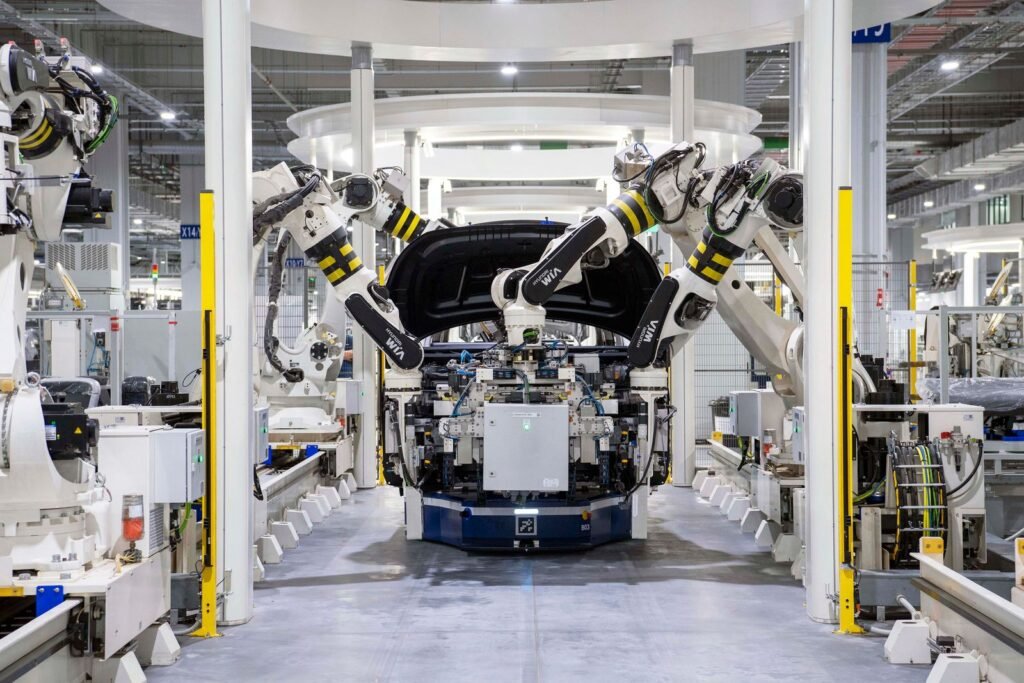
It is also worth noting that the most successful “new” robots in warehouses and logistics are not humanoids at all. They are mobile platforms, robotic arms on mobile bases, and specialized picking systems — machines that combine mobility with a fixed, optimized manipulation setup. These hybrids capture much of the flexibility people want from humanoids without paying the full price of a two-legged body. In many ways, they are the real competition for humanoids, not the traditional caged arm.
Maintenance, Lifespan, and Support
A comparison that stops at capability misses a factor that dominates real purchasing decisions: what it costs to keep the machine running year after year. Traditional industrial robots excel here because they are mature products. Their parts are standardized and stocked, their failure modes are well understood, and a network of integrators and technicians knows how to install, program, and repair them. A factory can typically get a replacement joint, a new controller board, or a service visit within days, and the maintenance schedule is predictable enough to budget years in advance.
Humanoids, by contrast, are still largely bespoke or low-volume machines. Many use custom actuators, specialized joints, and proprietary software stacks, which means spare parts may be scarce, repairs may require the original manufacturer, and maintenance expertise may be concentrated in a handful of engineers. Downtime is also more consequential: a fixed arm that fails stops one workstation, while a humanoid that fails may block a corridor, halt a multi-step workflow, or require a specialist to travel to the site.
Lifespan matters too. Industrial arms are routinely expected to run for a decade or more, with documented mean time between failures that lets operators plan replacement cycles. Humanoids have not yet accumulated that kind of operational history at scale, so their long-term reliability is still an open question rather than a specification. Buyers comparing the two should ask not just what each machine can do on day one, but what it will cost to own over five years — parts, service, software updates, and the risk of the vendor changing direction. On that measure, traditional robots currently win decisively, and humanoids will need years of deployed operation to close the gap.
The Honest Verdict
So which is better? The honest answer is that the question is incomplete without a task attached. For a fixed, high-volume, precision task, the traditional industrial robot wins by a wide margin, and it is not close. For a varied task in a human-built environment that cannot be redesigned, a humanoid has a unique advantage, but only if it is reliable enough — and reliability is precisely where humanoids are weakest today.
The most likely future is not a victory for one form over the other, but a division of labor. Fixed arms will keep doing what they do best, faster and cheaper than ever. Mobile manipulators and specialized robots will handle the growing middle ground of logistics and flexible manufacturing. Humanoids will mature gradually, starting with narrow, supervised roles in controlled workplaces, and expanding only as their reliability, cost, and safety improve.
For anyone deciding where to invest attention — as an engineer, a business owner, or simply a curious reader — the useful question is not “will humanoids replace industrial robots?” but “what does this specific task actually require?” Count the variations, measure the volume, price the downtime, and check the safety requirements. The robot that fits those numbers is the right robot, whatever shape it happens to be.
To go deeper, our Robotics & Physical AI category covers the underlying technologies — vision, simulation, and robot software — that both robot types depend on, and the TechBist blog carries our latest explainers. You can also start from the TechBist homepage for more plain-language technology guides.
Frequently Asked Questions
Are humanoid robots already working in factories?
A few are in pilot programs and limited trials, usually supervised and performing narrow tasks such as moving totes or simple assembly steps. They are not yet doing general factory work at scale. Most factory automation remains traditional industrial robots, mobile robots, and specialized picking systems, which are proven, economical, and reliable.
Why do humanoid demos look so impressive if the robots are not ready?
Demonstrations are usually performed in controlled settings: a prepared floor, a rehearsed task, a known object, and often a team of engineers nearby. A demo proves that a capability is possible, not that it is reliable enough for an eight-hour shift in a real workplace. The gap between “can do it once” and “does it ten thousand times without failure” is where most of the remaining work lies.
Is a humanoid robot just an industrial arm with legs?
No. Adding legs changes the entire engineering problem: balance, whole-body coordination, power management, and safety near people all become central concerns. An industrial arm assumes a stable base and a controlled workspace; a humanoid must create its own stability with every step. The software, actuators, and testing are substantially different.
Will humanoids eventually replace industrial arms?
Unlikely in full. Industrial arms are optimized for speed, precision, and cost in fixed tasks, and those advantages will persist. Humanoids are more likely to take on tasks that fixed arms cannot do — varied work in human environments — while arms keep the high-volume, repetitive work. Expect coexistence, not replacement.
What should I learn if I want to work on humanoids?
Start with the fundamentals that both robot types share: programming, control theory, and robot software frameworks. Then add the humanoid-specific topics: bipedal locomotion, balance control, whole-body planning, and human-robot interaction. Hands-on experience with any real robot, even a small one, teaches more about the gap between simulation and reality than any amount of video watching.
1 thought on “Humanoid Robots vs Traditional Industrial Robots”