
For the past few years, artificial intelligence has mostly lived behind glass. You typed into a chat window, and words came back. You uploaded a photo, and a label came back. You asked a question, and an answer appeared. It was impressive, but it was also distant: the intelligence stayed inside the screen, and you did the physical work yourself.
Physical AI changes that arrangement. It is the branch of artificial intelligence concerned with systems that act in the real world — robots, vehicles, machines, and devices that perceive their surroundings, make decisions, and move, grasp, lift, or navigate as a result. Instead of only answering questions about the world, physical AI touches the world. A warehouse robot that picks a box, a humanoid that walks across a factory floor, a farm machine that identifies and removes weeds, and a self-driving car that merges onto a highway are all expressions of the same idea: intelligence with a body.
This guide explains what physical AI is, how it differs from both chatbots and traditional automation, what makes it possible now, where it is already working, and what problems remain unsolved. If you are new to robotics, this is the place to start before exploring the rest of our robotics coverage.
When AI Leaves the Screen
The simplest way to understand physical AI is to compare it with the AI most people already know. A chatbot takes text in and produces text out. Its entire world is language. It never has to worry about gravity, friction, a slippery floor, or a door that is stuck. If it makes a mistake, the cost is a wrong sentence, and you can correct it in the next message.
A physical AI system faces a different reality. Its inputs come from cameras, depth sensors, microphones, force sensors, and joint encoders, all of which are noisy and imperfect. Its outputs are motor commands: turn this wheel, close this gripper, shift this weight. If it makes a mistake, the cost can be a dropped object, a collision, or a damaged machine. It cannot ask the user to rephrase the question; it must cope with the situation it is actually in, in real time.
That difference is why physical AI is often described as “embodied” intelligence. The intelligence is not a disembodied mind floating in a data center; it is tied to a particular body with particular sensors, actuators, and physical limits. A robot with wheels experiences the world differently from a robot with legs, and a drone experiences it differently from a robotic arm bolted to a table. The body shapes what the AI can perceive, what it can do, and what it must learn.
This embodiment also changes what “good performance” means. A chatbot is judged by the quality of its answers. A physical AI system is judged by whether it completes a task safely, reliably, and repeatedly, in environments that change from one moment to the next. A warehouse robot that picks correctly 99 percent of the time but drops a fragile item the other 1 percent is not good enough for production. Reliability, not cleverness, is the currency of physical AI.
What “Physical AI” Actually Means
The term “physical AI” is relatively new, but the idea behind it is not. Researchers have studied embodied intelligence for decades, and the field draws on robotics, computer vision, control theory, and machine learning. What is new is the convergence: modern AI models — the same kind of models that power language and image tools — are now being applied to robots, and they are beginning to generalize across tasks in ways that older, hand-programmed robots could not.
It helps to distinguish physical AI from three nearby ideas. First, it is not the same as a chatbot with a speaker. Putting a voice assistant in a smart speaker does not make it physical AI, because the speaker does not act on the physical world in any meaningful way. Second, it is not the same as traditional industrial automation. A factory robot that repeats one programmed motion thousands of times is automated, but it is not intelligent: change the position of the part by a few centimeters, and it fails. Third, it is not science fiction. Physical AI systems do not have general intelligence or consciousness; they are narrow systems trained for particular kinds of perception, planning, and control, and they fail in ways that are often surprising to people who expect them to be smarter than they are.
A useful working definition is this: physical AI is AI that closes the loop between sensing and acting in the physical world. It perceives, it decides, and it acts, and then it perceives the result of its action and adjusts. That loop — sense, decide, act, sense again — is the heart of the field, and everything else is detail.
The concept is closely related to embodied artificial intelligence, which studies how intelligence emerges from interaction between a body and its environment rather than from abstract reasoning alone. Readers who want the academic framing can start with the overview of embodied artificial intelligence, which traces the idea from early robotics research to today’s learning-based systems.
The Three Capabilities: See, Think, Act
Every physical AI system, however complex, rests on three capabilities that must work together. If any one of them is weak, the whole system suffers.
Perception is the first capability: building a useful understanding of the surroundings from sensor data. For a robot, this means more than recognizing objects in a photograph. It means estimating distances, tracking moving things, understanding which surfaces are solid and which are soft, and knowing where its own body is in space. Cameras provide rich detail but struggle in poor light; depth sensors provide geometry but limited range; force sensors tell the robot how hard it is gripping, which no camera can. Fusing these signals into a coherent picture of the world, dozens of times per second, is one of the field’s core engineering challenges.
Planning and decision-making is the second capability: turning that picture into a course of action. A robot that needs to pick up a cup must decide where to grasp it, how to approach it without knocking over nearby objects, and what to do if the cup turns out to be heavier than expected. A delivery robot must plan a path through a building, avoid people, and replan when a corridor is blocked. Modern approaches increasingly use learned models for this layer — models trained on large amounts of robot experience — rather than hand-written rules, because the real world contains too many variations for rules to cover. The trade-off is predictability: learned planners can handle novelty better, but their behavior is harder to guarantee in advance.
Action is the third capability: executing the plan through motors, grippers, wheels, or legs, with the precision and gentleness the task requires. This is where physics bites. A plan that looks perfect in simulation can fail if a wheel slips, a cable snags, or a joint wears. Good physical AI systems therefore monitor their own execution continuously, comparing what they expected to happen with what actually happened, and correcting on the fly. A gripper that feels resistance it did not expect should pause and reconsider, not squeeze harder.
When these three capabilities work together smoothly, the result looks almost magical: a robot that navigates a cluttered room, picks up an unfamiliar object, and hands it to a person. When they do not, the result looks clumsy. Most of the progress in physical AI in recent years has come not from any single breakthrough, but from steady improvements in all three layers at once, plus better ways to train and test them together.
Physical AI vs Traditional Automation
It is worth pausing on the difference between physical AI and the automation that factories have used for decades, because the distinction explains both the promise and the hype.
Traditional industrial robots are marvels of precision. A welding robot on a car assembly line repeats the same motion with sub-millimeter accuracy, thousands of times a day, for years. But that precision depends on a controlled environment: parts arrive in exactly the same place, lighting is fixed, and nothing unexpected enters the workspace. Engineers spend enormous effort arranging the world to suit the robot, building fixtures, guides, and safety cages that remove uncertainty.
Physical AI aims to invert that relationship: instead of arranging the world to suit the robot, the robot adapts to the world as it finds it. A physical AI picking system should handle boxes of different sizes, orientations, and conditions without reprogramming. A humanoid working alongside people should cope with a cluttered floor and a colleague who steps into its path. This adaptability is the prize, and it is also the reason physical AI is hard: the system must handle the long tail of real-world variation that traditional automation simply engineered away.
That does not mean traditional automation is obsolete. For high-volume, unchanging tasks, a fixed, programmed robot remains cheaper, faster, and more reliable than an AI-driven one. The sensible view is that physical AI expands the range of tasks robots can handle — into warehouses with mixed goods, hospitals with unpredictable layouts, farms with changing weather, and homes with endless variety — rather than replacing every existing robot. The two approaches will coexist, and choosing between them is a practical question about variation, volume, and cost, not a contest between old and new.
Where You Can Already See It
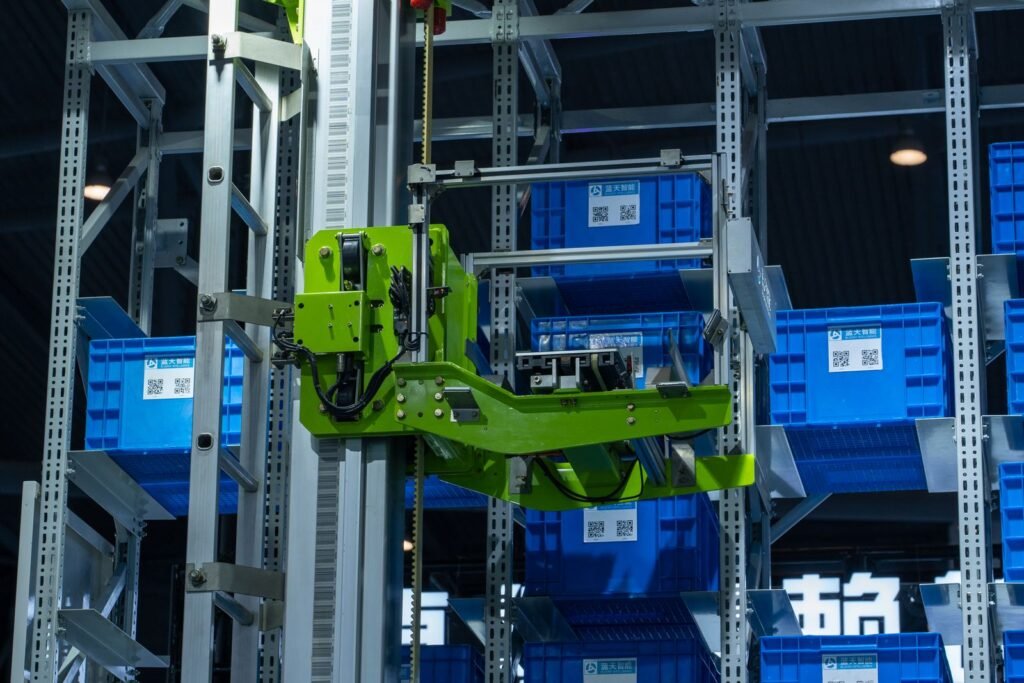
Physical AI is not a distant promise; it is already working in places most people never see. Warehouses are the clearest example. Large logistics companies use fleets of mobile robots that carry shelves to human pickers, and increasingly use robotic arms that pick individual items from bins. These systems combine vision, grasping, and fleet coordination, and they operate at a scale that would have been impossible with fixed automation alone.
Agriculture is another early adopter. Machines that drive through fields use cameras and AI models to distinguish crops from weeds and spray only the weeds, reducing chemical use. Harvesting robots are learning to pick soft fruit without bruising it — a task that combines delicate perception with gentle manipulation, and one that has resisted automation for decades precisely because every piece of fruit is different.
Healthcare and logistics provide further examples. Hospitals use mobile robots to deliver supplies through corridors shared with staff and patients. Delivery robots roll along sidewalks in some cities, navigating pedestrians and curbs. Drones inspect power lines, wind turbines, and bridges, using vision to spot damage that would be dangerous or expensive for humans to check. Each of these systems is narrow and specialized, but together they show a pattern: physical AI first succeeds where the environment is structured enough to be manageable but variable enough that fixed automation fails.
Humanoid robots attract the most attention, and they deserve a note of caution. A humanoid shape is useful in environments built for humans — stairs, door handles, tools designed for hands — but it is also the hardest form to engineer, because balance and whole-body coordination are genuinely difficult problems. The impressive demonstrations you see online are real, but they are usually performed in controlled settings with extensive preparation. The gap between a demonstration and a product that works an eight-hour shift, every day, in a real workplace, is where most of the remaining work lies.
Why Physical AI Is Accelerating Now
If the ideas are decades old, why is physical AI suddenly everywhere in the news? Several trends converged at roughly the same time.
First, the models got better. The same advances that made language and image models dramatically more capable — larger models, more training data, better training methods — are now being applied to robot perception and planning. Vision-language models, which connect images and language, let robots understand instructions like “pick up the red mug next to the sink” in a way that older systems could not. These models are not a complete solution, but they give robots a much richer understanding of scenes and tasks.
Second, simulation got cheaper and more realistic. Training a robot purely in the real world is slow and expensive: every hour of robot experience requires a physical robot, a safe space, and human supervision. Simulation lets researchers generate vast amounts of training experience quickly, and then transfer the learned skills to real robots — a process known as sim-to-real transfer. The gap between simulation and reality remains a real problem, but it is narrowing, and simulation-first development has dramatically accelerated progress.
Third, hardware got cheaper and more capable. Cameras, depth sensors, processors, and motors that once cost a fortune are now available at prices that make experimentation affordable. Open-source robotics software, particularly the Robot Operating System, has lowered the barrier further by giving researchers and hobbyists a shared foundation instead of requiring everyone to build from scratch.
Fourth, investment followed the demos. Humanoid robots and general-purpose robot platforms have attracted substantial funding, which buys more robots, more engineers, and more real-world testing. Funding alone does not solve hard problems, but it does accelerate the cycle of building, testing, and learning from failure.
Platforms from major hardware and software companies are also making the field more accessible. For example, NVIDIA’s robotics platform provides simulation, perception, and control tools that many teams build on, and its Isaac robotics platform is a useful starting point for readers who want to see what a modern physical AI development stack looks like.
The Hard Problems Nobody Has Solved Yet
Enthusiasm aside, physical AI still faces problems that are genuinely hard, and honest coverage should name them.
Safety is the first. A robot that works near people must be safe even when it makes a mistake, and “safe” is a much stricter standard than “usually correct.” Engineers use layered safeguards — force limits, collision detection, emergency stops, and restricted operating zones — but proving safety for a learning-based system that behaves differently in new situations remains an open challenge. Regulators, insurers, and workplaces are still developing the standards for robots that share space with humans.
Reliability is the second. A system that works 95 percent of the time is a great demo and a terrible product. Real deployments need reliability measured in nines, across weather, lighting, wear, and the endless variation of real environments. Closing that gap requires not just better models but better testing: long-duration trials, adversarial testing, and careful monitoring of deployed systems so failures are caught and understood.
Data is the third. Robot learning needs robot data — recordings of sensors and actions during real tasks — and that data is far scarcer than text or images on the internet. Collecting it is slow, and different robots produce different data, which makes sharing difficult. The field is experimenting with shared datasets, teleoperation (where humans drive robots remotely to generate examples), and simulation, but data scarcity remains a bottleneck.
Cost and energy are the fourth. Capable robots are still expensive, and the computation they carry consumes significant power. A humanoid that needs frequent recharging or a support team to keep running is not yet an economical worker for most tasks. Costs are falling, but the economics of physical AI will decide which applications succeed far more than the technology demos will.
Finally, there is the question of generalization. Today’s physical AI systems are good at tasks they were trained for and fragile outside them. A picking robot trained on boxes may fail on bags; a navigation system trained in one building may struggle in another. Building systems that generalize robustly — the way a person who can use one kitchen can figure out another — is the field’s central scientific challenge, and it is far from solved.
What Physical AI Means for Everyday People
For most readers, the important question is not technical but practical: what will physical AI change in ordinary life, and when?
The honest answer is: gradually, and unevenly. The first changes are already visible in logistics and manufacturing, where robots handle more of the dull, dirty, and dangerous work. Over time, expect more capable machines in agriculture, construction, and healthcare support — fields with labor shortages and physically demanding tasks. Domestic robots remain the hardest case, because homes are the most unstructured environments of all, but even there, specialized machines for cleaning, lawn care, and delivery are steadily improving.
The employment question deserves a measured answer. Physical AI will change some jobs, particularly those involving repetitive physical tasks in structured settings, and it will create others: robot supervision, maintenance, deployment, and the design of human-robot workflows. History suggests the transition is messy rather than apocalyptic — new roles appear, old roles change, and the adjustment is hardest for people whose work is narrowly defined around a single automatable task. Learning to work alongside robots, and to supervise rather than compete with them, is a practical skill worth developing.
There are also questions of privacy and control. A robot that navigates your home or workplace carries cameras and microphones, and it generates detailed data about your environment. Who owns that data, where it is stored, and who can access it are questions that should be answered before such machines become common, not after. The same security discipline that applies to AI applications generally — which we covered in our guide on how to secure an AI application — applies with even greater force to machines that move through physical space.
For readers who want to follow this field, the best approach is to learn the fundamentals: how robots perceive, how they plan, and how they are tested. Our Robotics & Physical AI category covers those topics in depth, from vision systems to simulation software to the robot operating systems that tie it all together. You can also browse the latest explainers on the TechBist blog, or return to the TechBist homepage whenever you need a plain-language guide to a new technology.
Frequently Asked Questions
Is physical AI the same as a robot?
Not exactly. A robot is the body — the hardware with sensors and motors. Physical AI is the intelligence that lets that body perceive, decide, and act in unstructured environments. A traditional factory robot has a body but little intelligence; a physical AI system combines the body with learned perception, planning, and control so it can adapt to situations it was not explicitly programmed for.
Will humanoid robots replace human workers soon?
No, not soon and not broadly. Humanoids are promising for environments built for humans, but they are expensive, energy-hungry, and still unreliable over long shifts. The near-term impact of physical AI is in specialized machines — warehouse robots, agricultural machines, delivery robots, inspection drones — rather than general-purpose humanoids. Humanoids will arrive gradually, starting with narrow tasks in controlled workplaces.
How is physical AI different from a self-driving car?
A self-driving car is one application of physical AI, not a separate category. It perceives its surroundings with cameras and sensors, plans a route, and acts through steering, braking, and acceleration. The same sense-decide-act loop appears in warehouse robots, drones, and humanoids. The difference is the body and the environment: a car operates on roads with traffic rules, while other robots face warehouses, farms, hospitals, or homes.
Do physical AI robots learn on the job?
Mostly no, not yet. Most deployed systems run fixed, trained models and do not learn continuously from experience, because uncontrolled learning can produce unsafe or unpredictable behavior. Learning usually happens offline: data is collected, models are trained and tested, and updates are deployed after validation. Research into safe, continual learning is active, but it is not standard practice in production systems.
What skills are useful for working in physical AI?
A mix of software, robotics, and practical engineering. Programming (especially Python), basic machine learning, and familiarity with robot software frameworks are the core skills. Equally valuable are testing, safety engineering, and the ability to work with hardware — debugging a robot requires patience with the physical world, not just code. Curiosity about how machines fail is, frankly, one of the most useful traits in the field.
1 thought on “What Is Physical AI”